


“This AI Translator helps me understand academic materials in multiple languages while keeping the meaning accurate. It's much better than traditional translators.”

Annika Palmari
International Student
Work through math, science, English, history, coding, and more with step-by-step explanations — not copy-paste answers. Paste a question, upload a worksheet photo, or describe what you are stuck on, then use the breakdown to learn the method, check your work, and cite sources your school expects. Free to try on this page; continue structured tutoring in Knowant Tutor when you want ongoing practice.
Write faster with Knowant and get more done in less time.
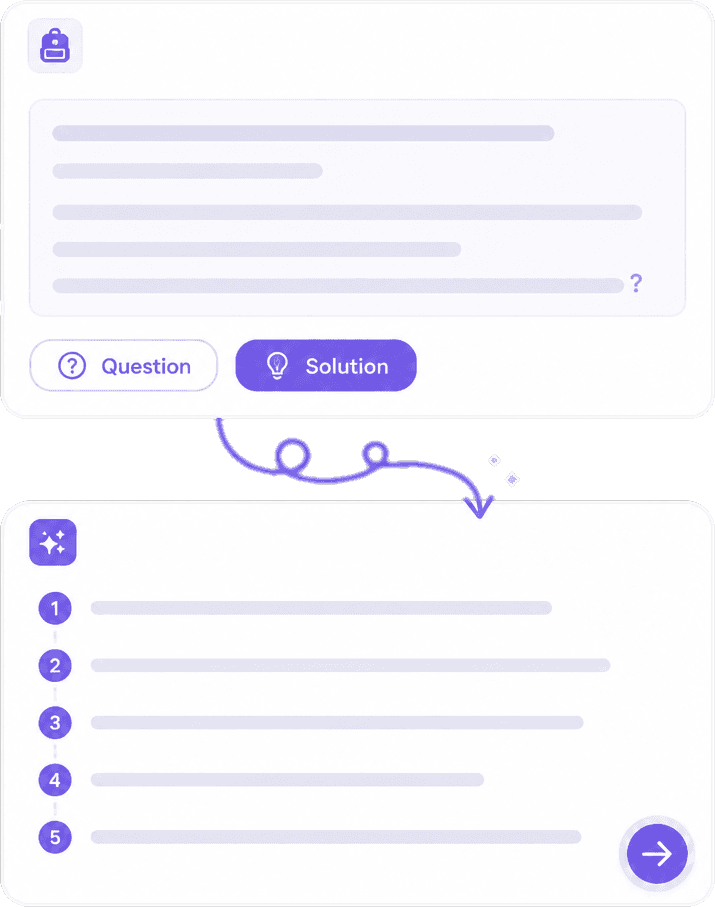
One place for problems that span courses: fractions and geometry, stoichiometry, grammar and thesis statements, timelines in history, supply-and-demand graphs, and introductory Python or Java errors. The helper works best when you paste the full question, given values, and what you already tried so the steps match your assignment.
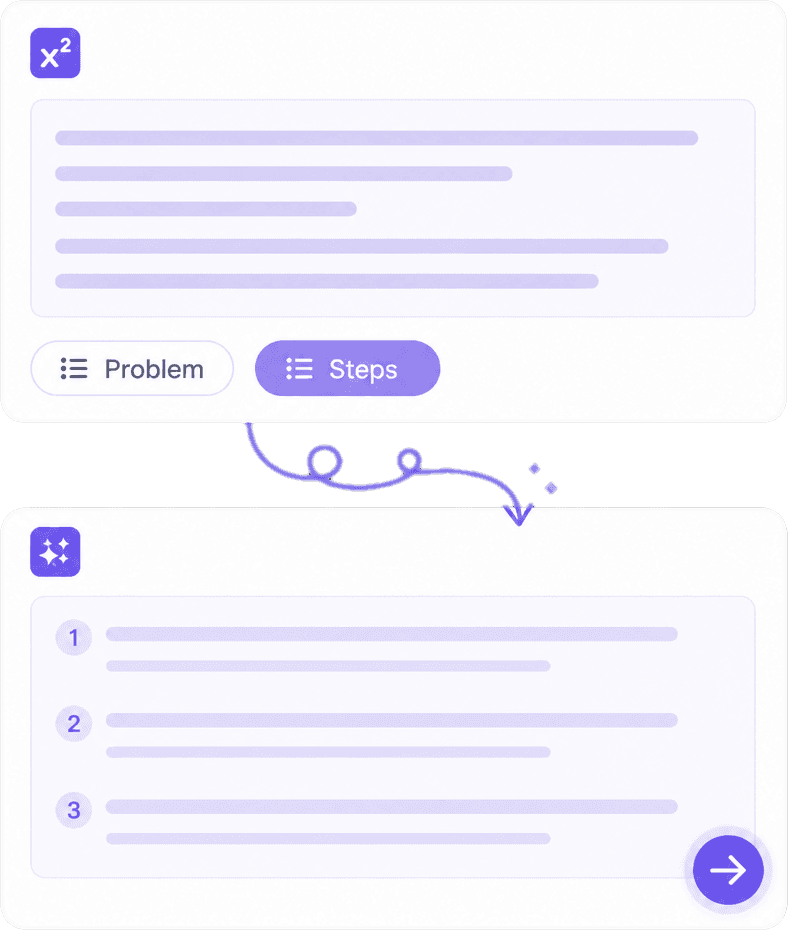
See how to set up an equation, which theorem applies, or how to structure a paragraph — not only a final line. That mirrors how teachers grade partial credit and helps you fix the exact step where your thinking diverged. Re-do the calculation yourself on paper after reading; that repetition is what sticks for quizzes.
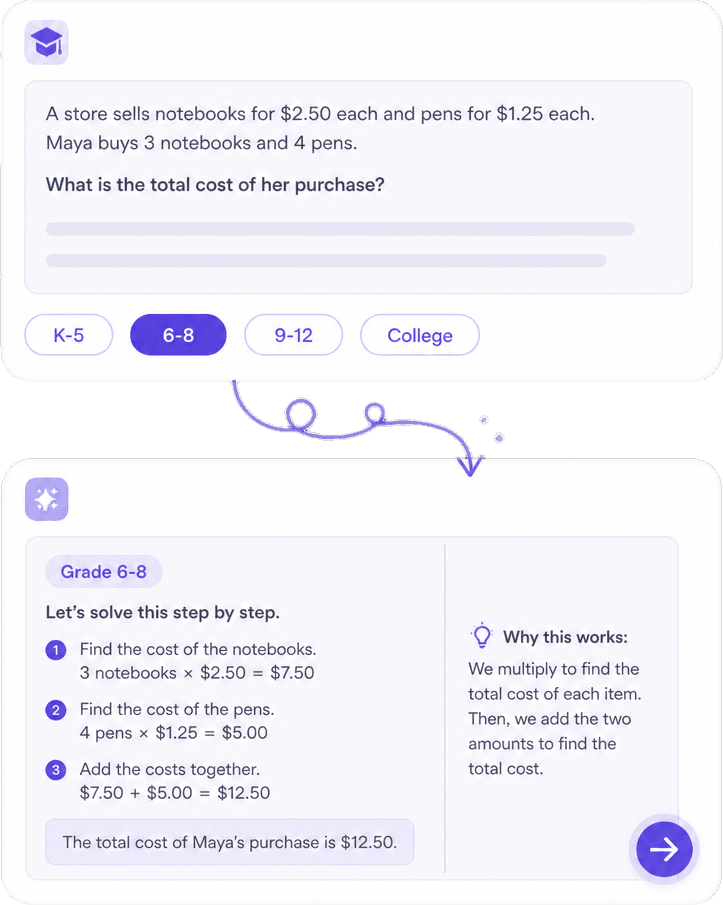
Elementary explanations stay concrete with visuals and simple terms; high school and college responses can include symbolic math, citations to standard models, and programming idioms. Tell the tool your level or course name when prompts allow so jargon matches what your textbook uses.
Finishing an assignment without understanding it does not help on the next quiz. This tool is built for learning: you see worked examples, vocabulary, and common mistakes to avoid. Follow your instructor’s academic integrity policy, write answers in your own words, and use Tutor at https://www.knowant.com/product/learn-with-ai when you need guided practice beyond a single problem.
Use AI to clarify definitions and solution paths, then practice without looking until you can explain it aloud.
Compare your attempt to a worked example to spot sign errors, unit mistakes, or missing evidence in essays.
Turn one hard problem into a template for similar questions on study sheets — especially for math and science.
Move from single questions to guided practice and quizzes at https://www.knowant.com/product/learn-with-ai.
Ask clearly, read the explanation, then prove you learned — three habits that turn AI help into real study time instead of shortcutting.
Type the problem, paste the prompt, or upload a clear photo of the worksheet. Include given data, diagram labels, and your course level so steps align with how your class teaches the topic.
Follow each step and note vocabulary you did not know. Pause to solve the next line yourself before scrolling — that is where understanding forms.
Produce final work in your words, show scratch work your teacher requires, and cite books or sites you relied on. If policy allows AI assistance, disclose it the way your syllabus says.
Learners and families use Knowant to clarify tough problems, prep for tests, and build confidence — with human review before anything is turned in.
“This AI Translator helps me understand academic materials in multiple languages while keeping the meaning accurate. It's much better than traditional translators.”
Annika Palmari
“I use it to generate eye-catching YouTube thumbnails and social media graphics. The image quality is fantastic and saves me a lot of time.”

Ryan Hoffman
“Converting invoices and purchase reports into Excel has become effortless. The table recognition is incredibly accurate.”

Austin Distel
“I use it to generate social media posts and ads. The content is always engaging and relevant to my audience.”

Brooke cagle
Subjects, grade levels, academic honesty, and how to use explanations without cheating on graded work.
An AI homework helper is a learning tool that explains how to approach assignments — math, science, writing, and more — with structured steps and concept reminders. Knowant’s version is meant for understanding and checking your reasoning, not for submitting generated text as finished homework. Treat every response as a tutor’s whiteboard: useful, but something you still need to translate into your own work and citations.
Common subjects include arithmetic through calculus, physics, chemistry, biology, English and literature, history, geography, economics, statistics, and introductory programming. Grade level depends on how you describe the course; elementary prompts should ask for simple language, while AP or university work can request formal notation. If a topic is highly specialized, bring the exact unit or textbook section for better alignment.
Yes. You can get setups, algebraic moves, unit conversions, and interpretation of the final value. Always verify arithmetic yourself and match the method your instructor taught — classes sometimes require a specific approach (factoring vs quadratic formula, for example). Use the steps to learn, then solve a similar problem without help to confirm you retained the skill.
Policies differ by school and assignment. Many teachers allow AI for hints and explanations but forbid turning in AI-written essays or copied solutions. Read your syllabus, ask when unsure, and never use any tool on proctored exams unless explicitly permitted. Ethical use means you understand the material, write submissions yourself, and cite sources — including when AI helped you brainstorm or clarify.
You can get homework help on this page within free usage limits without paying upfront. Creating a Knowant account may unlock longer sessions, uploads, and Tutor features for ongoing study at https://www.knowant.com/product/learn-with-ai when you outgrow one-off questions.
When image upload is available, a clear, well-lit photo of the printed question works better than blurry screenshots. Crop to the relevant problem and include any diagrams or tables. After you receive an explanation, still show the work your teacher expects on paper or in the LMS — do not assume a photo upload replaces that requirement.
Follow your instructor’s format. Some courses want a short note in acknowledgments; others ban AI entirely. Even when disclosure is optional, cite primary sources (textbook, article, lab manual) for facts and quotes. AI can misstate details — confirm definitions, dates, and formulas against trusted materials before you submit.
This free tool answers specific questions with explanations you can apply immediately. Knowant Tutor at https://www.knowant.com/product/learn-with-ai is better for sustained learning: practice sets, quiz-style review, and conversational coaching across a chapter or exam. Use the helper to unblock one problem; use Tutor when you need a study plan for the whole course.
 Knowant
Stuck on homework in math, physics, chemistry, biology, English, history, economics, or computer science? Get clear explanations that walk through concepts and calculations so you can solve similar questions yourself. Use it to check reasoning, learn vocabulary, and prepare for exams — not to submit AI text as your own. Always follow school rules, cite textbooks and sources you use, and rewrite solutions in your voice before handing work in.