
Exam preparation is less about studying harder the night before and more about studying in a way your brain can actually keep. Whether you are doing SSC preparation, UPSC exam preparation, NEET preparation, bank exam preparation, or a college midterm, the pattern is the same: start early, make the work active, and test yourself before the examiner does.
Searches for preparation for exam stay high year-round. What is rising fast is AI for exam preparation — students using quizzes, flashcards, mind maps, and an AI tutor to turn notes into practice. This KnowAnt guide mixes the old habits that still work with the new tools that save time.
At KnowAnt, we treat exam prep like any other writing or learning job: clear plan, short sessions, proof you actually remember. Explore Learn with AI when you want quizzes, flashcards, mind maps, and a tutor in one place.

Table of Contents
- What Good Exam Preparation Actually Looks Like
- 1. Give Yourself Enough Time
- 2. Organise Your Study Space
- 3. Use Mind Maps, Flow Charts, and Diagrams
- 4. Practice on Old Papers and Timed Quizzes
- 5. Explain Answers Out Loud (Teach to Learn)
- 6. Study Groups That Do Not Waste Time
- 7. Take Real Breaks
- 8. Snack Like You Care About Your Brain
- 9. Plan Exam Day Before Exam Day
- 10. Sleep and Water Are Not Optional
- AI for Exam Preparation: Quizzes, Flashcards, Mind Maps & Tutor
- Exam Preparation by Exam Type
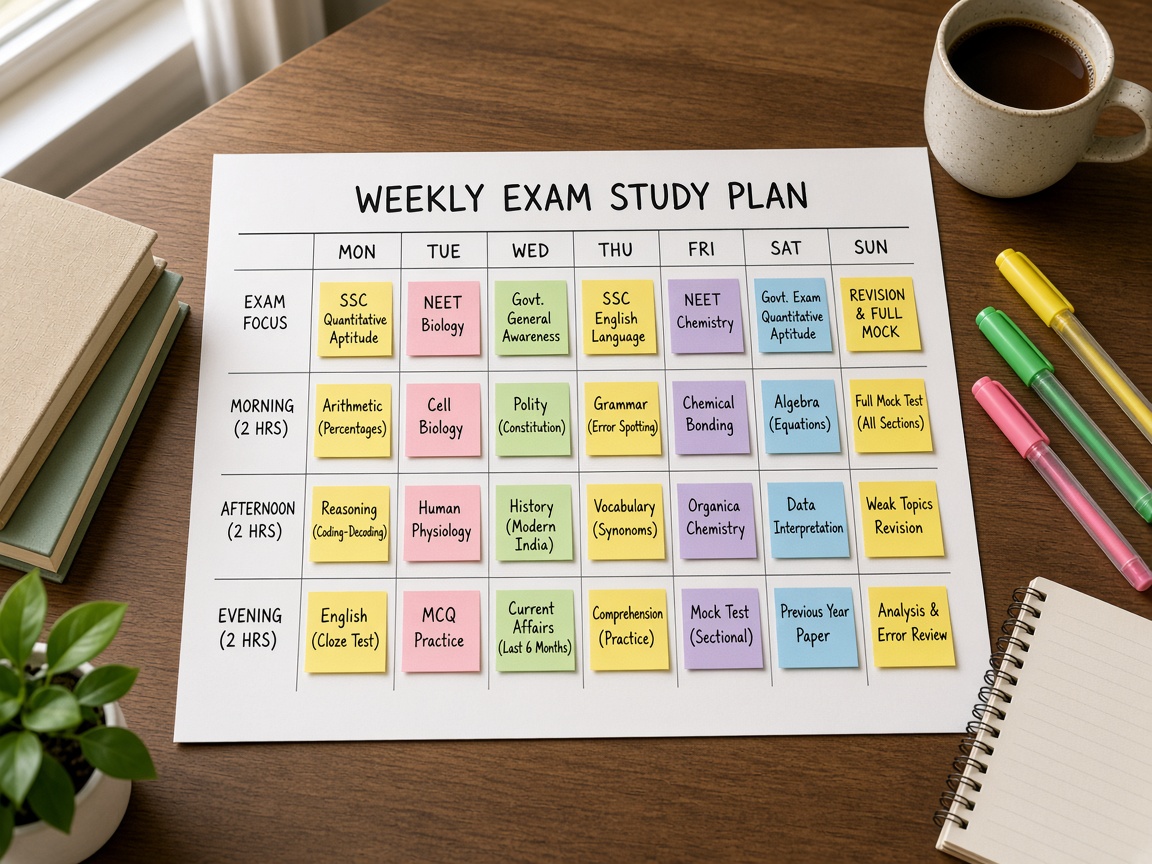
- A Simple Weekly Study Rhythm
- Frequently Asked Questions
- Conclusion
What Good Exam Preparation Actually Looks Like
Bad prep is rereading the same PDF until the words look familiar. Familiar is not the same as recalled.
Good competitive exam preparation usually has four pieces:
- A calendar with the exam date and weekly targets
- Active study — writing, speaking, solving, not only highlighting
- Self-tests — flashcards, quizzes, past papers under time
- Recovery — sleep, food, short breaks so the next session is sharp
That mix works for school boards, government exam preparation, railway exam preparation, teaching tests like TET and CTET, and professional papers like NET or GATE. The syllabus changes. The brain does not.
1. Give Yourself Enough Time
Cramming can get you through a quiz. It collapses under a three-hour paper.
Start with the exam date and work backwards. Split the syllabus into chunks. Put harder subjects earlier in the week when your attention is better. For SSC CGL exam preparation or UPSC preparation, that might mean months of spaced revision, not five heroic nights.
A practical rule: if a topic takes two hours to learn the first time, budget another hour across later days to review it. Review is part of the plan, not leftover time.
2. Organise Your Study Space
Your desk does not need to look like a stationery shop. It needs to make starting easy.
- One clear surface for notes and one device for practice
- Phone in another room or in Focus mode for the session
- Light you can sit under for an hour without squinting
- Materials for today’s topic only — not every book you own
If home is loud, rotate: library mornings, home evenings. Consistency of session beats consistency of location.
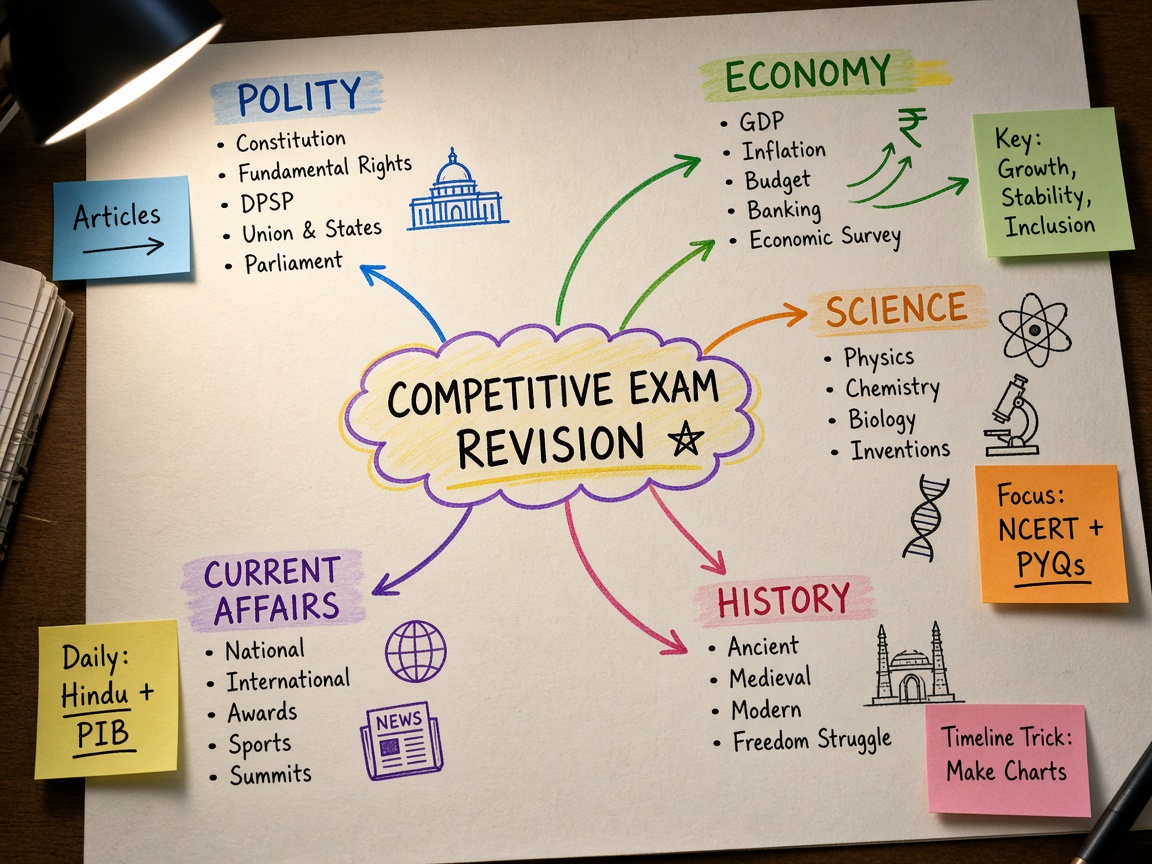
3. Use Mind Maps, Flow Charts, and Diagrams
Dense paragraphs hide structure. Drawing forces structure into the open.
At the start of a topic, dump everything you remember onto a blank page. Closer to the exam, compress that into one page: a mind map, a flowchart, or a one-sheet diagram. For polity or history, timelines and cause–effect maps beat underlined textbooks. For science and maths, process diagrams and formula sheets do the same job.
If drawing from scratch feels slow, generate a first-pass map from your notes with the mind map tools in Learn with AI, then redraw the weak branches by hand. The redraw is where memory sticks.
4. Practice on Old Papers and Timed Quizzes
Past papers are the closest rehearsal to the real day. They show question style, timing pressure, and which chapters the paper actually loves.
Do at least some papers timed, with no notes open. Mark them like a harsh examiner. Keep an error log: topic, mistake type (concept / careless / time), and one fix.
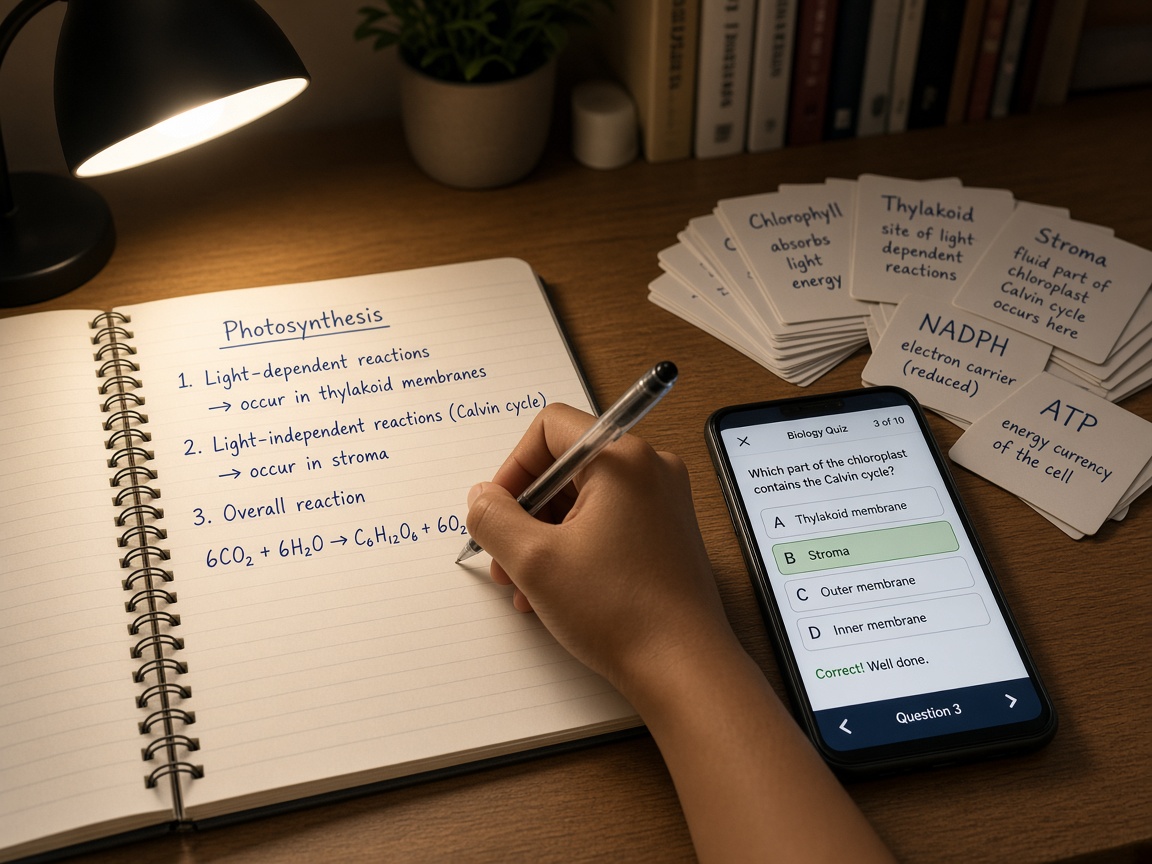
Between full papers, use short quizzes pulled from your own notes. Ten sharp questions after a chapter beat an hour of passive reading.
5. Explain Answers Out Loud (Teach to Learn)
If you cannot explain a concept without peeking, you do not own it yet.
Pick a question. Answer it as if a friend asked. Use simple words. Notice where you stall — that stall is your next study block.
This works especially well for essay papers, ethics answers, and teaching exams (TET exam preparation, CTET exam preparation, NET exam preparation), where clarity of explanation is the skill being tested.
An AI tutor helps when you have no study partner at midnight: ask it to play the confused student, then fix the gaps in your explanation.
6. Study Groups That Do Not Waste Time
Groups help when they have a job. They fail when they become gossip with notebooks nearby.
Rules that keep groups useful:
- One chapter or one past paper per meet
- Everyone arrives having attempted the questions alone
- Rotate who teaches the hard topic
- Cap the session (60–90 minutes)
Two serious friends beat eight distracted ones.
7. Take Real Breaks
Your attention is not a battery you can shame into lasting six hours. It is a muscle that recovers with rest.
Try 40–50 minutes of focus, then 8–10 minutes away from screens. Stand, drink water, look outside. Do not “break” by opening Instagram — that is a second job for your attention.
Longer days need a real meal break, not another energy drink.
8. Snack Like You Care About Your Brain
Exam season junk food feels like a reward. It often feels like fog ninety minutes later.
Keep easy options nearby: fruit, nuts, yoghurt, eggs, wholegrain toast, water. Save sugar for after a finished block, not as fuel for starting one.
Hydration matters more than students admit. Mild dehydration shows up as headaches and slow recall — which you will blame on the syllabus.
9. Plan Exam Day Before Exam Day
The night before is for logistics, not new chapters.
- Admit card, ID, stationery, water bottle
- Route and buffer time for traffic
- What you will eat that morning
- Which sections you will attempt first
During the paper: read instructions, allocate time by marks, leave two minutes to check roll number and unanswered bubbles. Panic loses more marks than hard questions.
10. Sleep and Water Are Not Optional
Sleep is when memory consolidates. Trading sleep for one more chapter is usually a bad trade.
Aim for a normal bedtime the week of the exam, not only the night before. If anxiety keeps you awake, write tomorrow’s first three tasks on paper and put the books away. Your brain trusts a written plan more than a spinning worry.
AI for Exam Preparation: Quizzes, Flashcards, Mind Maps & Tutor
AI for exam preparation is not a shortcut that replaces thinking. It is a way to multiply the useful parts of study: practice, retrieval, and explanation.
Here is a clean workflow on KnowAnt Learn with AI:
| Need | What to do | Why it helps |
|---|---|---|
| Test yourself | Generate a quiz from notes or a PDF | Forces retrieval before the real exam |
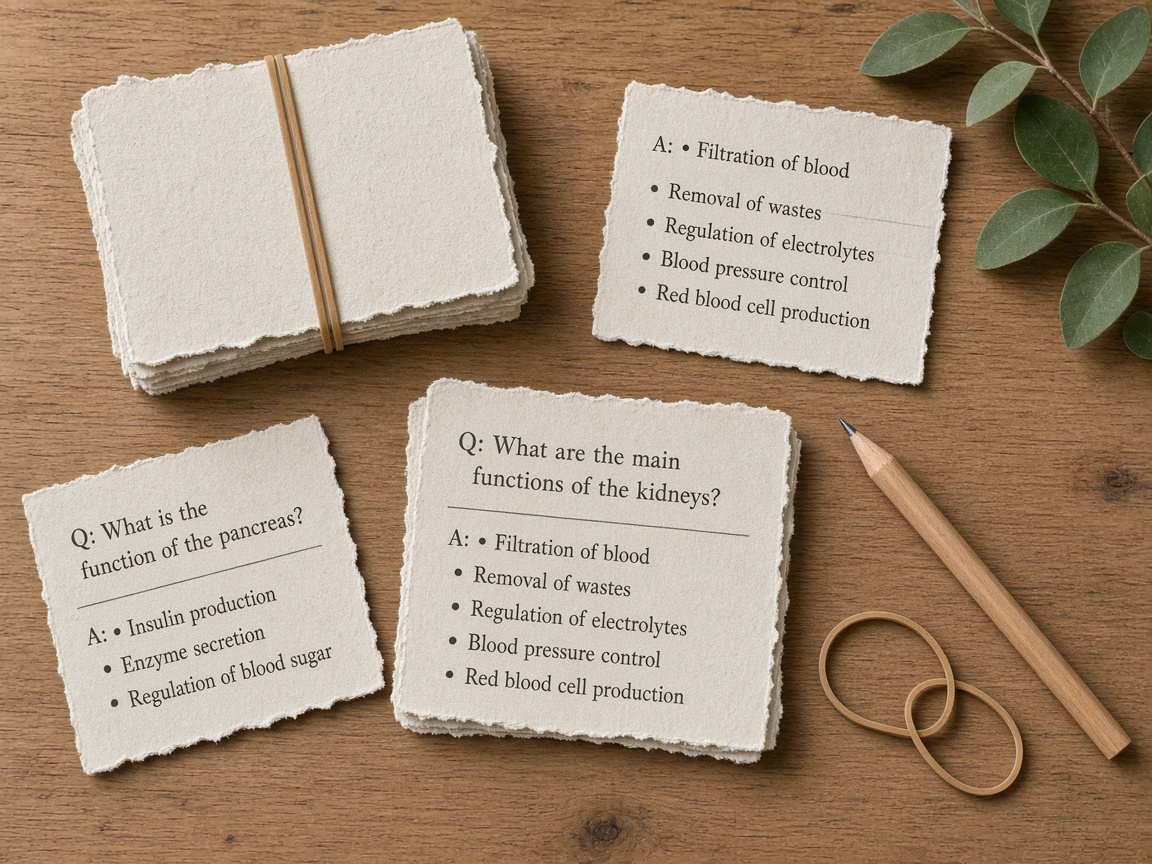
| Memorise facts | Build flashcards for dates, formulas, definitions | Short, repeatable active recall |
| See the big picture | Create a mind map of a chapter | Shows links textbooks bury in paragraphs |
| Unstick a concept | Ask the AI tutor to explain simply, then quiz you | Personal coaching without waiting for class |
Use AI after you have skimmed the chapter once. Upload your notes, not only a random Wikipedia page. Then close the chat and do a blank-page recall. The tool prepares the drill. You still take the drill.
Exam Preparation by Exam Type
Same principles, different emphasis.
SSC preparation / SSC exam preparation / SSC CGL
Syllabus breadth + speed. Daily quizzes for GA and quant, timed sectional tests, and formula flashcards. Mind maps help for polity and economy links.
Government exam preparation (UPSC and state PSC)
Depth + writing. Concept maps for GS, weekly essay practice, and a tutor loop for answer structure. Past papers matter more than collecting new PDFs.
NEET exam preparation
High-volume MCQs. Chapter-wise quizzes, error logs, and diagram redraws for biology. Sleep is part of rank, not a luxury.
Bank exam preparation / IBPS
Accuracy under time. Quant and reasoning drills every day; current affairs in short flashcard decks, not endless scrolling.
TET / CTET exam preparation
Pedagogy + content. Explain methods out loud; use quizzes for child development theories and classroom scenarios.
NET / UGC NET exam preparation
Paper I reasoning plus subject depth. Mind maps for research aptitude themes; flashcards for thinkers and dates.
Railway exam preparation (RRB)
Pattern familiarity. Timed mocks and short daily GA quizzes beat rare marathon sessions.
CAT, GATE, CLAT, IELTS
Skill exams. Deliberate practice on weak question types beats rereading theory notes.
If you need clean writing for applications or school leave notes alongside exam season, KnowAnt’s grammar checker and how to write a letter guides stay useful when forms and emails pile up.

A Simple Weekly Study Rhythm
Use this as a template and bend it to your exam date.
| Day | Focus |
|---|---|
| Mon | New hard topic + 20 flashcards |
| Tue | Practice set / past paper section + error log |
| Wed | Second subject + mind map of Monday’s topic |
| Thu | Timed quiz + tutor questions on weak spots |
| Fri | Mixed revision + light mock |
| Sat | Full timed paper or long practice block |
| Sun | Light review, plan next week, rest |
Two subjects a day is plenty for most people. Four “quick” subjects usually means none of them stick.
Frequently Asked Questions
How do I start preparation for exam if I am late?
Cut the syllabus to high-weight topics, switch almost everything to practice and past papers, and use short quizzes and flashcards for rapid retrieval. Do not pretend you can reread everything.
Is AI for exam preparation better than coaching?
Different jobs. Coaching gives structure and peer pressure. AI gives on-demand quizzes, explanations, and maps from your notes. Many students use both. Neither replaces timed practice.
How many hours should I study for competitive exam preparation?
Quality beats a brag number. Focused 4–6 hours with breaks often beats 10 hours of half-attention. Match hours to the exam timeline and your mock scores, not to what a stranger posts online.
What is the best way for SSC and bank exam preparation?
Daily sectional practice, weekly full mocks, and a tight current-affairs flashcard habit. Track accuracy and time per section.
Do mind maps really help in UPSC or NEET?
Yes when they force structure — themes, processes, linkages. A pretty map you never redraw is decoration. A messy map you rebuild weekly is revision.
How can KnowAnt help with exam preparation?
Learn with AI brings quiz, flashcards, mind map, and tutor modes together so you can turn notes into practice without juggling five apps.
Conclusion
Strong exam preparation is boring in the best way: enough time, a clear desk, diagrams that show structure, past papers that hurt a little, explanations out loud, short breaks, decent food, a plan for the morning, and sleep.
Layer AI for exam preparation on top of that — not instead of it. Use Learn with AI for quizzes when you need retrieval, flashcards when you need memory, mind maps when a chapter feels foggy, and a tutor when you are stuck. Then close the laptop and prove you can do it alone.
That is how preparation for exam stops feeling like panic and starts feeling like a system — whether the paper says SSC, UPSC, NEET, bank, TET, or the midterm on your college portal.